Inspired by nature
Over millions of years, organisms have evolved materials and structures that minimize weight while maximizing mechanical performance. Engineers and architects have long looked to biology for design principles that are difficult to achieve synthetically.
But how do these materials exhibit such remarkable properties?
The answer lies in hierarchy. Nacre (a.k.a. mother-of-pearl) achieves both high strength and high toughness — a combination that usually requires a trade-off — through a layered microarchitecture that operates across multiple length scales. I used multi-scale chemo-mechanical characterization to correlate nacre's chemical and mechanical properties at the nano-, micro-, and macro-scales.
Residual stress mapped with Raman Spectroscopy
Over the past two decades, interest in translating nacre's mechanical properties into biomimetic materials has grown exponentially. Its micro-architecture — a classic brick-and-mortar arrangement of aragonite platelets bound by an organic matrix — has inspired a generation of advanced structural materials. These outstanding properties have been largely attributed to that platelet-matrix interplay.
This work reveals an additional hierarchical level: crystallographically co-oriented stacks of aragonite platelets (aragonite columns), roughly 20 µm tall, that contribute independently to toughening. Our findings suggest these columns store energy through cooperative plastic deformation — a mechanism not captured by brick-and-mortar models alone.
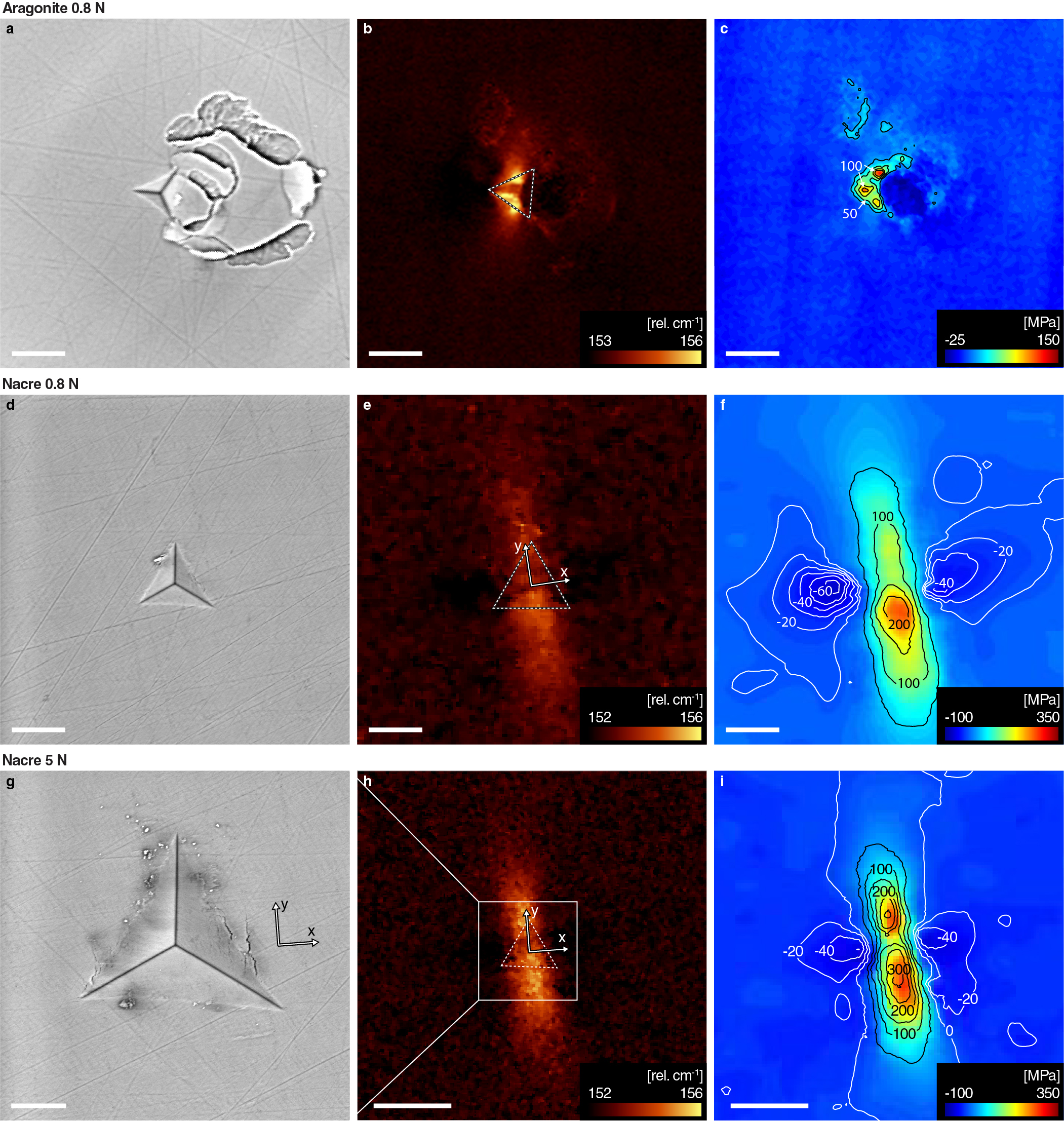
Residual stress calculation using the Piezo-Raman relationship
Each row shows SEM observation, Raman peak shift map, and stress analysis for the same region: (a–c) micro-indented monolithic aragonite (0.8 N load), (d–f) nacre (0.8 N), and (g–i) nacre (10 N).
(a) SEM image of the indent; large cracks originate from the edges.
(b) False-color heatmap of the L1 peak shift (152–154.5 rel cm⁻¹); indent position marked with a dashed line.
(c) Contour and false-color heatmap of residual stress computed from the piezo-Raman relationship.
(d, g) SEM images of nacre indents show minimal crack propagation. The aragonite platelet width direction (x-axis) and growth direction (y-axis) are labeled.
(e, h) Raman peak position maps show larger peak shifts along the growth direction.
(f, i) Iso-stress contours and heatmap reveal anisotropic residual stress distribution along the growth direction.
Scale bars: 20 µm in (a–f), 100 µm in (g–i).
A New Toughening Mechanism
The chemo-mechanical characterization and toughening mechanism presented here offer new insight for scientists and engineers working on structural bioinspired materials. The techniques — particularly piezo-Raman spectroscopy for spatially resolved stress mapping — can guide the development of biomimetic strategies in materials science, nanotechnology, coatings, and biomedical design.
Critically, the existence of a hierarchical length scale beyond the submicron brick-and-mortar structure opens new opportunities for biomimetic implementation — including in 3D printing, where multi-scale geometry can now be directly encoded into fabrication.
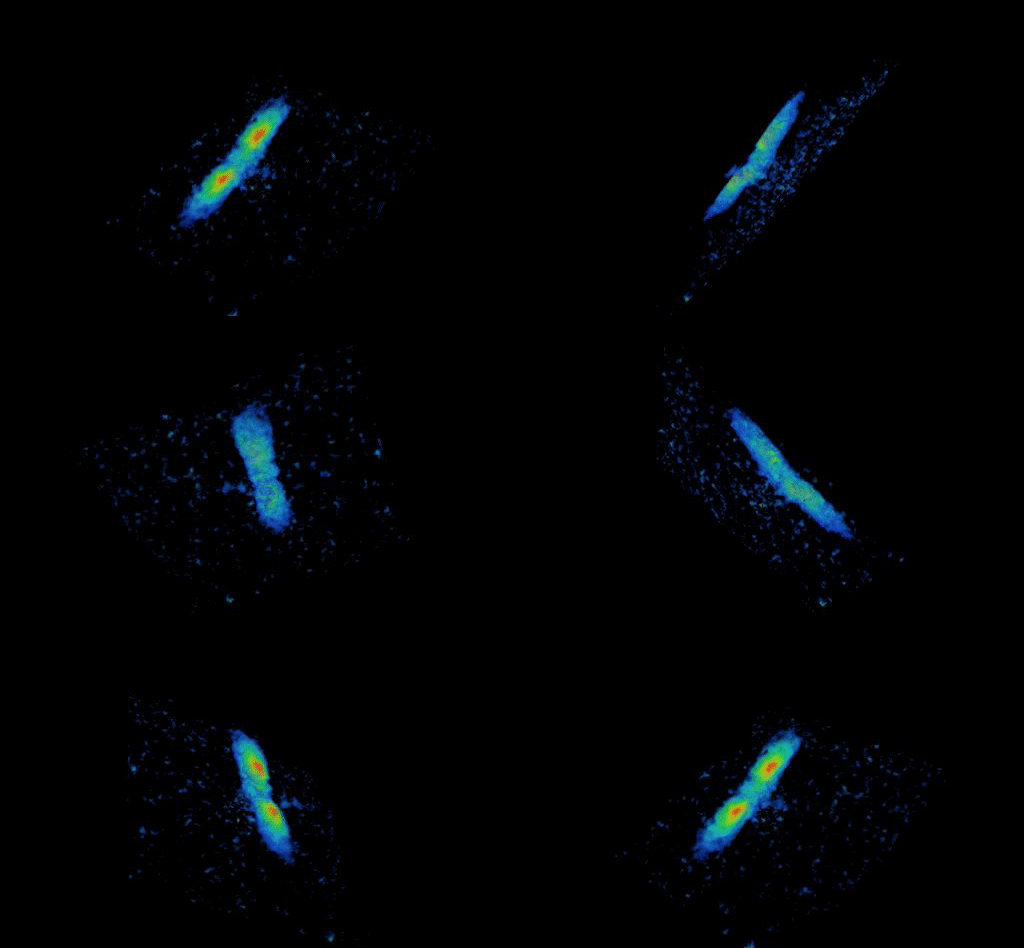
3D Stress Map